Spades Relax Classic Card Game
- 4.5
- Rating
- 10.00K
- Installs
- Free
- Price

 Analysis by App-foxy
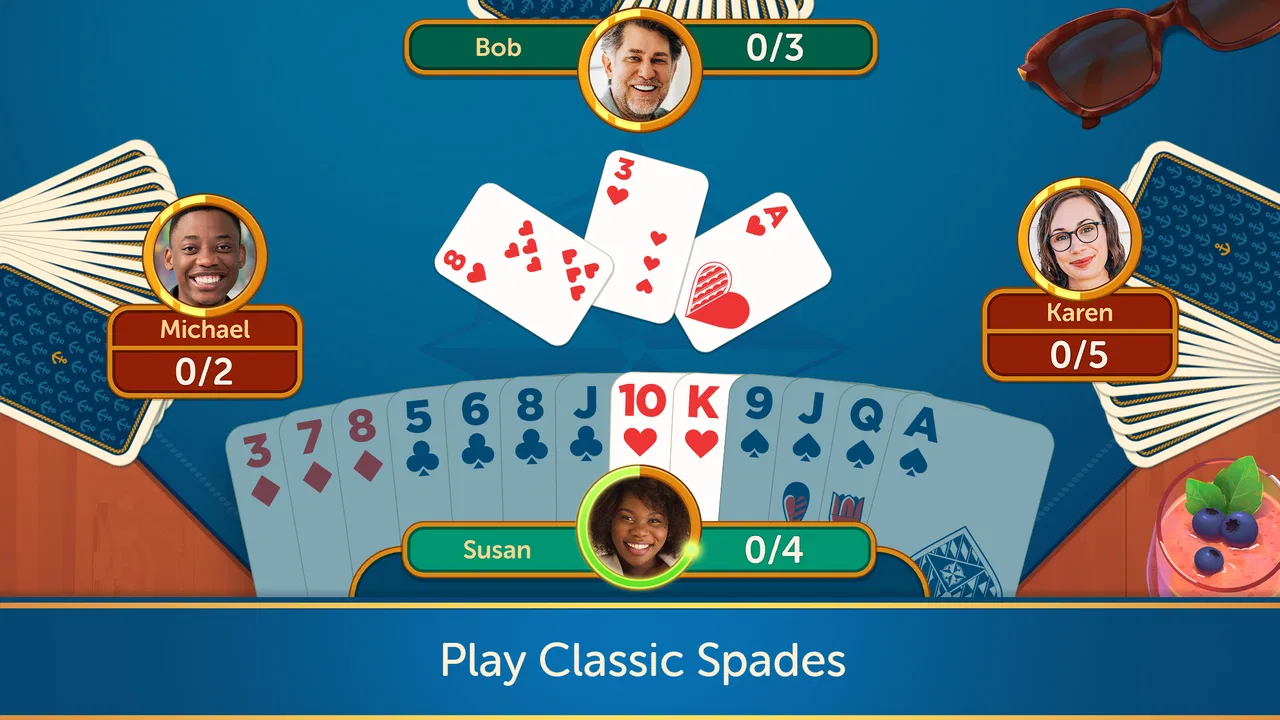
Spades Relax Classic Card Game is the kind of card game I can open when I want a focused match without committing to a large action game or a complicated strategy system. It is a free multiplayer card game from GameDuell INC., built around Spades and presented as a relaxed way to play online. I found the appeal less in flashy presentation and more in the familiar rhythm: assess the hand, predict how many tricks you can take, communicate through your play, and try to avoid giving away points.
That familiarity makes it approachable, but Spades is not completely casual once the cards are dealt. A careless bid can shape the whole round, and a player who treats every high card as an automatic win will quickly discover why timing matters. My first impression was that this is best viewed as a light online meeting place for people who already enjoy trick-taking games, while newcomers can still learn if they take the opening matches slowly.
What to expect before your first match
The game belongs squarely in the card category, and its central attraction is the classic Spades format rather than a collection of unrelated mini-games. That distinction is useful when deciding whether to install it. If you are looking for a fast puzzle, a solo patience game, or a card battler with collectible decks, this will not scratch the same itch. If you like partnership-based trick taking and the small decisions that build across a hand, the format has a much better chance of holding your attention.
You May Also Like

 AccuWeather: Weather Radar
AccuWeather Review: A Quick, Clear Forecast for Everyday Decisions
For everyday plans, the best forecast is the one you can understand quickly. AccuWeather makes rain timing, radar, and local conditions easy to act on, with a few trade-offs.

 Hill Climb Racing
Why Hill Climb Racing Still Turns Crashes Into One More Run
A tiny car, a bumpy hill and one more upgrade: Hill Climb Racing keeps resurfacing because its simple chaos makes every near-miss feel personal.

 AliExpress - Shopping App
AliExpress Makes Global Shopping Feel Personal, but Shoppers Bear the Risk
AliExpress turns a global marketplace into a pocket-sized discovery engine. Its reach is useful, its shopping loop compelling, and its trade-offs easy to miss.

 Lords Mobile: Kingdom Wars
Lords Mobile Is a Kingdom-Building Routine, Not a Quick Match
A case-by-case verdict on the building, battles, device demands, and social commitments that make Lords Mobile rewarding for some players and exhausting for others.

 PDF Scanner app - TapScanner
TapScanner Makes Paperwork Easier to Capture, Check, and Share
TapScanner makes scanning with a phone feel less like a rescue operation and more like a dependable step in getting work done. Its capture tools are useful, though not flawless.

 Block Blast!
 Shows How Much a Puzzle Game Can Leave Out
A quiet grid game shows why puzzle players increasingly value instant clarity, repeatable skill and low-pressure play—and where the genre still needs to catch up.
More From Our News Desk
View All News


The store presents it as free to install, with optional in-app purchases ranging from $0.99 to $149.99 per item. I would approach that pricing structure with a simple rule: begin by learning the game without spending anything, then decide whether the paid options add value to the way you play. The basic reason to try it is the card play itself, not the expectation that purchases will make you understand bidding or improve your judgment.
It is marked for Everyone, which makes it an easy recommendation for households where different age groups enjoy traditional card games. That does not remove the normal need for good online manners, especially in multiplayer settings. A calm table is more enjoyable than one where a player reacts badly to a lost trick, so I would treat the social side as part of the experience rather than an afterthought.
The game has an average rating of 4.5 from around 188 ratings, with around 37 written reviews, and it has passed 10K+ installs. Those figures suggest a modest but active audience rather than the scale of a huge mainstream platform. In practical terms, I would install it because the rules suit me, not merely because it is popular. A smaller community can feel comfortable, although the quality of any online match depends on who happens to be at the table.
Why Spades feels different from ordinary card games
The important idea for a new player is that Spades is usually played with partners, and spades act as the trump suit. Before the tricks begin, players estimate how many they expect to win. That estimate is not a decorative choice: it gives the round its direction. A hand with several strong cards may look promising, but the order in which those cards appear and the cards held by the other players can change everything.
I like this structure because it gives every card two jobs. A card can help win a trick, but it can also be useful as a way to force another player to spend a stronger card. Low cards are not automatically worthless, and a high card is not always best played immediately. That makes the game more thoughtful than a simple “play the largest card” contest.
Compared with a standard solitaire app, the main difference is uncertainty created by other people. Compared with a collectible card game, there is no need to build a deck before you can participate in the basic challenge. The trade-off is that you have less control over the cards you receive, so patience and adaptation matter more than preparation.
Starting smoothly and finding your first useful win
I’d use this section to make the first session feel manageable: focus on understanding the table and choosing a sensible bid, rather than trying to master every tactic at once. One small habit that helps is to decide what you want your next card to achieve before tapping it; that pause can turn an uncertain opening into a useful lesson about how the hand is unfolding.
Install with the right expectations
After installing, I would give myself a few minutes to understand the opening screen and the route into a match instead of tapping quickly through everything. The current version is 2026.22.179, and it supports devices running Android 7.1 or later. That broad minimum requirement makes it accessible on older compatible Android devices, but the actual comfort of play will still depend on the device’s screen, connection, and general responsiveness.
The first useful goal is not to win an entire session. It is to complete one round while making deliberate choices. Watch how the game presents your hand, identify the suit that was led, and remember that you normally need to follow that suit when possible. If you cannot follow, that is when a spade may become especially important. Keeping those three ideas in view prevents the first match from becoming a blur of random taps.
I also recommend reading each prompt before confirming a bid or card. In a trick-taking game, a quick tap can have consequences several plays later. New players often focus so closely on the card they want to play that they overlook the number they promised to take. My practical advice is to pause after receiving the hand, count likely winners, and then make a conservative estimate rather than chasing an exciting but unlikely total.
How I would approach the first hand
Start by separating your cards mentally into likely winners, possible winners, and cards you expect to lose. A strong spade is usually more reliable than a high card in another suit, but even that strength depends on whether opponents have already used their spades. If you hold several cards in one suit, that can be useful because you may be able to control when you run out of that suit later.
For a first meaningful success, aim to make a sound bid and then protect it. Suppose you believe you can take three tricks. Do not immediately spend your best card just because it can win the current trick. Consider whether a smaller card will do, whether your partner appears to be winning already, and whether saving a spade could rescue the hand later. This is the first non-obvious lesson I would want a friend to know: winning a trick is not always the same as making the best play.
Pay attention to what has already been played. If several cards from a suit are gone, the remaining cards in that suit become easier to evaluate. If an opponent has failed to follow a suit, that player may be able to use spades when that suit is led again. You do not need to memorize every card to benefit from this. Simply remembering who appears to be short in a suit can improve your next decision.
Partnership play adds another layer. Your partner’s card may already be strong enough to win, so playing an even stronger card could waste a resource. On the other hand, if your partner seems unable to take the trick and your bid needs another win, you may need to intervene. This is why I find the game more rewarding after the first few rounds: the hand stops being a collection of isolated choices and starts feeling like a conversation conducted through cards.
Confusions that can make the opening feel harder
The biggest early confusion is the difference between bidding and winning. Your bid is a forecast, not a guarantee. A player can hold several attractive cards and still fall short because opponents control the timing, or because spades are used before the expected winners can appear. I would not judge the game after one unlucky hand; instead, compare the bid with the information you had at the time.
Another common mistake is treating spades as cards that should be played whenever possible. They are trump cards, but their value depends on the trick. Using a spade to win a small trick may leave you without a way to stop an opponent later. Conversely, holding every spade too carefully can also be a mistake if you need to secure your contract. The useful question is not “Can this spade win?” but “What does winning this trick accomplish?”
New players can also misunderstand the role of low cards. A low card may be exactly what you need when you want to lose a trick safely, especially after another player has already shown control. Keeping a few low cards can help you avoid taking extra tricks that damage the round. This is a subtle trade-off and one of the reasons I would not recommend judging your performance only by the number of tricks you win.
The online format may raise a practical question: is this mainly for experienced Spades players? I do not think it has to be, but beginners should expect a learning curve because the rules are simple while the decisions are not. If you have never played before, use the first matches as observation sessions. Notice how bidding, trump timing, and partner support work before worrying about playing quickly.
A realistic everyday use case
For me, the strongest use case is a short break when I want something more engaging than scrolling but less demanding than a long campaign. I can imagine opening it during a commute break or after dinner, playing a few hands, and stopping once I have had enough. The appeal is that each hand has a clear shape, so the session does not require remembering a large story or managing a complicated inventory.
It can also work for someone who enjoys traditional card nights but does not always have three other people available. The online table supplies the missing opponents and partner, while the familiar rules provide a starting point. Still, it is not a perfect replacement for sitting with friends. Face-to-face play includes conversation, custom house rules, and a shared atmosphere that a mobile table cannot fully reproduce.
A second useful scenario is learning the game before joining a physical Spades group. Playing digitally lets you practice counting likely tricks and recognizing when to use a trump card without putting a new player on the spot. I would then carry one habit into real play: after every trick, briefly ask what information it revealed. That habit matters more than memorizing a long list of tactics.
Where the experience may frustrate you
The relaxed presentation should not be confused with a completely stress-free game. Multiplayer results can feel outside your control, particularly when a partner’s decisions do not match your plan or when the deal gives you few useful options. If you prefer games where careful planning almost always produces a predictable result, this may feel unfair even though uncertainty is part of Spades.
There is also a social trade-off in online play. A match is more interesting because real players make different choices, but that also means the pace and atmosphere can vary. Someone who wants a fully private, interruption-free experience may prefer a solo card game. Someone who enjoys adapting to unpredictable partners may see that same variation as the main attraction.
The purchase range is another reason to stay deliberate. The game is free to start, but the presence of optional items means I would not treat every available purchase as necessary. I would first establish whether I enjoy the core matches and whether I am returning regularly. For a casual player who opens the game only occasionally, spending may not improve the central skill of reading a hand.
Moving beyond the first successful round
Once you can complete a hand without guessing at every card, the next step is to review your decisions rather than simply chasing wins. Ask whether your bid was too ambitious, whether you used a spade too early, and whether you ignored a chance to support your partner. This short review is more useful than immediately starting another match because it turns a result into a lesson.
A good intermediate habit is to track one suit at a time. You do not need perfect memory. Watch which players follow the led suit and which players cannot. That information can reveal who may be able to trump future tricks. This is a practical technique that makes the game feel less random without requiring complicated notation or a formal strategy guide.
Another improvement is learning to value the contract over individual glory. If your partner has already taken the trick and your own card cannot improve the outcome, saving a stronger card may be wiser. If your team still needs a trick, taking responsibility may be necessary even when it exposes a valuable card. The best move changes with the team’s position, which is why the same card can be correct in one round and wasteful in the next.
I would also resist trying to play at maximum speed. Fast decisions may feel satisfying, but they make it easier to overlook the suit led, forget the bid, or miss that a player has run out of a suit. A measured pace is especially helpful on a smaller phone screen, where the hand and table information may require a moment of attention. Speed can come later, after the sequence feels natural.
Who should choose it, and who should pass?
I would recommend Spades Relax Classic Card Game to players who enjoy classic trick-taking rules, online partnership play, and short sessions with meaningful decisions. It is particularly suitable for someone who wants a familiar card foundation but still likes the unpredictability of playing with other people. The Everyone age rating and free entry also make it easy to try without turning the first decision into a purchase.
I would suggest skipping it if your ideal card game is entirely solo, visually elaborate, or based on collecting and upgrading custom cards. It may also be a poor fit if you dislike bidding because the forecast at the beginning of a hand is central to the experience. Players who become annoyed by unlucky deals or imperfect partners should know that the game’s challenge comes partly from managing those situations rather than eliminating them.
Compared with a traditional physical deck, this version is more convenient and available when other players are not. Compared with a generic online card room, its identity is clearer because the focus is Spades rather than a broad menu of games. Compared with a competitive card battler, it asks less of you before the match but more of your judgment during each trick. That balance is its strongest reason to exist.
GameDuell INC. has positioned the release as a straightforward way to play this timeless multiplayer format on a mobile device. After spending time with it, my advice is to begin modestly: learn the hand flow, bid conservatively, watch which suits disappear, and treat the first completed contract as the real milestone. The most satisfying progress comes from making fewer careless decisions, not from forcing every hand to look heroic.
Overall, I see it as a useful, approachable choice for anyone who wants Spades available in a pocket-sized format. It is free to try, familiar enough for a first-time player, and deep enough to reward attention after the novelty wears off. The experience is not designed for people seeking a solitary puzzle or a highly controlled competitive system, but for the right player, Spades Relax Classic Card Game turns a simple deck into a steady test of judgment, timing, and partnership.
FAQs for Spades Relax Classic Card Game
01What are the main features of Spades Relax Classic Card Game?
Spades Relax Classic Card Game offers a user-friendly interface with smooth controls, customizable themes, and adjustable difficulty levels. It includes both single-player and multiplayer modes, allowing you to play with friends or against AI opponents. The game also provides detailed statistics to track your progress and improve your skills.
02Is Spades Relax Classic Card Game free to play?
Yes, Spades Relax Classic Card Game is free to download and play. However, it may include optional in-app purchases for additional features, themes, or to remove ads. These purchases are not necessary to enjoy the core gameplay but can enhance the overall experience.
03Does the game require an internet connection to play?
Spades Relax Classic Card Game can be played offline, making it perfect for enjoying a quick game on the go without needing an internet connection. However, if you want to play multiplayer games or access certain features, a stable internet connection will be required.
04How can I improve my skills in Spades Relax Classic Card Game?
To improve your skills, take advantage of the practice mode against AI opponents with varying difficulty levels. Regularly reviewing your game statistics and analyzing past games can provide insights into your strengths and areas for improvement. Engaging with online communities can also offer valuable tips and strategies.
05Are there any ads in Spades Relax Classic Card Game?
Yes, the game may include ads, especially in the free version. These ads help support the developers and allow the game to remain free. If you find ads disruptive, you may have the option to purchase an ad-free version or make in-app purchases to remove ads.
Pros
- Smooth
- intuitive interface enhances gameplay.
- Various difficulty levels for all players.
- Minimal ads keep focus on the game.
- Offline mode available for anytime play.
- Customizable themes add personal touch.
Cons
- Limited tutorial for new players.
- Occasional connectivity issues in multiplayer.
- Lacks advanced stats tracking.
- No chat feature during online play.
- In-app purchases can be pricey.

Spades Relax Classic Card Game
Gallery